What an AI Compute Platform Actually Does
From raw hardware to a running model
When someone talks about an AI compute platform, they are usually referring to the integrated stack of hardware and system software that trains and runs machine learning models. The phrase sounds broad because it is. An AI compute platform is not a single chip or a single server rack; it is the combination of accelerators, memory subsystems, interconnects, and scheduling software that turns research code into a working inference service. Understanding the layers inside that platform helps you see why one setup may handle a large language model easily while another struggles with the same workload.
The hardware layer: accelerators and memory
At the bottom sits the accelerator. Most production AI today runs on GPUs or dedicated AI accelerators, not general purpose CPUs. These chips are built for the dense matrix math that underpins neural networks. They contain thousands of simple cores that can perform many multiply-add operations in parallel. The difference between a consumer GPU and a data center accelerator often comes down to memory bandwidth and power efficiency. A model that fits entirely in the accelerator's local memory can run inference at high speed. Once the model exceeds that memory, the system must page data in from system RAM or across an interconnect, which slows throughput.
Memory bandwidth is the rate at which the accelerator can read and write its local memory. For model training, high bandwidth reduces the time spent moving data between compute units. For model inference, it determines how many tokens per second the system can generate. Power efficiency matters because a rack full of accelerators draws a lot of electricity and produces a lot of heat. A platform with better power efficiency can deliver more compute per watt, which directly affects total cost of ownership.
The interconnect layer: how accelerators talk to each other
One accelerator alone is rarely enough for modern models. Training a large language model requires hundreds or thousands of accelerators working together. The interconnect is the network that links them. It moves gradients, parameters, and intermediate results between chips. A slow interconnect creates bottlenecks, leaving accelerators idle while they wait for data. A fast interconnect keeps utilization high and training times shorter.

The interconnect also matters for inference in a different way. When a model is too large for a single accelerator, it must be split across several. The inference request then travels through the interconnect between layers of the model. Latency in that path adds directly to the time the user experiences. So the quality of the interconnect affects both training speed and inference responsiveness.
The system software layer: orchestration and scheduling
Hardware alone cannot run an AI workload. The system software layer includes the drivers, runtime libraries, and orchestration tools that let a training script use the accelerators. This layer handles tasks such as loading a model onto the right devices, managing memory allocation, and batching inference requests. Without well-optimized software, even the fastest accelerator will perform poorly.
One critical piece is the scheduler. Production AI systems serve many users at once. The scheduler decides which request runs on which accelerator, when to pause a long-running training job to let a priority inference through, and how to balance load across a cluster. A good scheduler increases utilization and reduces the number of accelerators you need to buy. A poor one leaves accelerators idle while users wait.
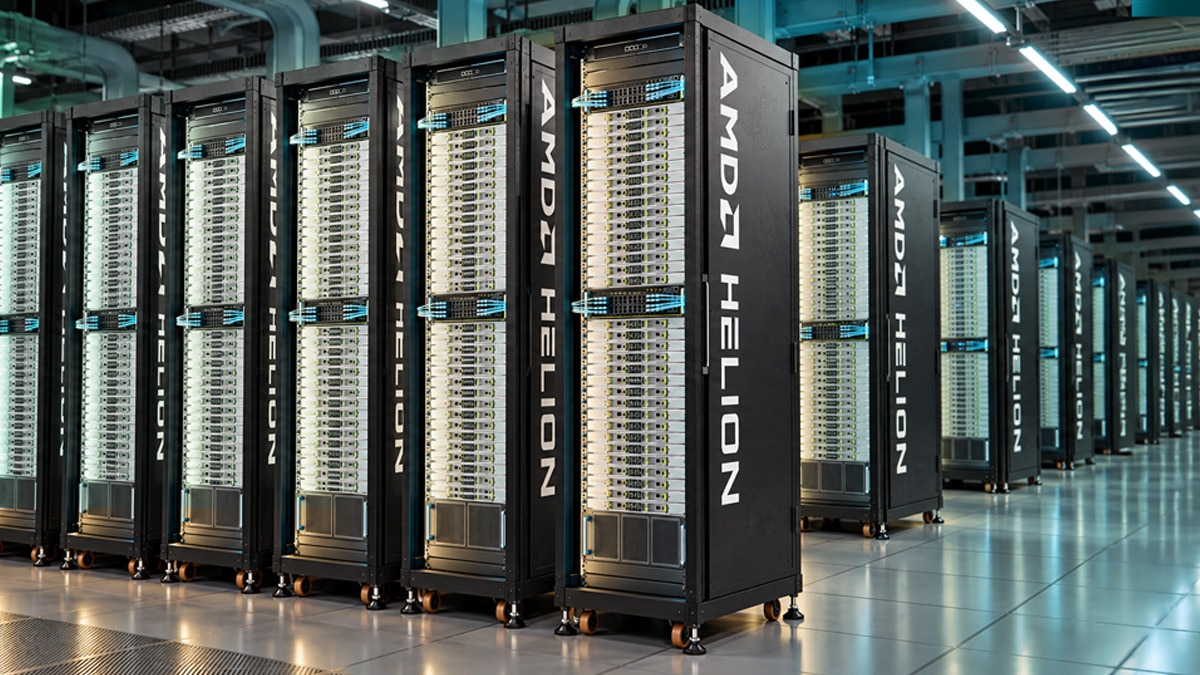
AMD plays in this space by offering CPUs, GPUs, and adaptive computing for data centers and AI PCs. The platform approach means that the hardware and the software stack are designed together, so the scheduler and runtime can take advantage of the specific memory layout and interconnect topology of the hardware underneath.
Model training versus model inference
These two tasks place different demands on the compute platform. Training is compute-bound. It runs for days or weeks, moving huge volumes of data through the accelerators. The priority is raw throughput and the ability to scale across many accelerators. Memory bandwidth matters because the model parameters must be updated frequently. Power efficiency matters because the electricity bill for a large training run can be substantial.
Inference is latency-sensitive. A user sending a prompt expects a response in seconds, not hours. The priority here is low latency and high throughput under unpredictable load. Batching helps: the scheduler groups several requests together and processes them in one pass through the accelerator. But if the batch is too large, latency grows. The platform must balance batch size, accelerator utilization, and response time.
Some platforms are designed to switch between training and inference. Others are optimized for one or the other. When you read specifications for an AI compute platform, look for numbers that match your use case. Training benchmarks measure throughput in teraFLOPs or samples per second. Inference benchmarks measure latency in milliseconds and throughput in tokens per second. The same hardware can look very good on one benchmark and poor on another.
Total cost of ownership and platform choices
The up-front price of accelerators and servers is only part of the equation. Total cost of ownership includes the power and cooling infrastructure needed to run them, the real estate they occupy, and the staff time required to maintain the software stack. A platform with higher power efficiency may cost more to buy but less to run. A platform with mature software tooling may need fewer engineers to keep it running.
Another factor is the interconnect. If the platform uses a proprietary interconnect, you are locked into that vendor's ecosystem for switches and cabling. An open interconnect gives you more flexibility but may require more tuning. The trade-off between vendor lock-in and integration effort is one that every team must make based on its own expertise and budget.

How to think about your own needs
If you are choosing an AI compute platform, start with the model you plan to run. How large is it? Does it fit on one accelerator, or does it need several? What is the memory footprint? Then consider the workload mix. Are you training from scratch most of the time, or are you running inference on a pre-trained model? The answers will narrow down the hardware choices. Only then should you compare the software ecosystem, the interconnect options, and the power efficiency numbers.
For many teams, the right platform is not the fastest one but the one that fits their operational constraints. A small team may prefer a platform with excellent documentation and a simple scheduler, even if the raw performance is lower. A large cloud provider may care most about power efficiency and the ability to scale to thousands of accelerators. There is no single best platform. There is only the best platform for a given problem.